The Marketing Illusion
Walk into any premium sports retailer today, and you will be met with a towering wall of luxury-priced football boots. For the better part of a decade, the legacy footwear giants have conditioned players to believe that elite performance requires a massive financial sacrifice. If you want carbon fiber, ultra-thin synthetic uppers, and the exact boots worn by Champions League finalists, you have to pay the premium.
Then, Antoine Griezmann stepped onto the pitch wearing Decathlon’s in-house brand, Kipsta.
Griezmann’s adoption of the Kipsta CLR 7 Elite FG, most notably in the striking “Red Storm” and “Meteor” white/yellow colorways, sent a shockwave through the equipment industry. This was not a retired legend wearing a budget boot for a paycheck; this was an active World Cup winner and La Liga talisman choosing to play his domestic and European campaigns in a boot that costs roughly £80.

The CLR 7 Elite FG is not a takedown model. It is not a cheap replica. It is a fully realized, elite-tier speed boot that forces a profound reckoning in the market. By matching the technological specifications of its vastly more expensive rivals, the CLR 7 strips away the marketing fluff and asks a dangerous question: what are we actually paying for when we buy football boots?
To answer that, we have to look past the logo and examine the engineering.
How to Choose the Perfect Football Boots for Your Playing Style


The rise of the Kipsta CLR 7 Elite serves as the ultimate masterclass in footwear evaluation. When you remove the brand prestige from the equation, you are forced to evaluate a boot based purely on its anatomical and mechanical merits.
Choosing the perfect football boot should never start with the colorway or the athlete endorsing it. It must start with an honest assessment of your own biomechanics and your tactical role on the pitch. Are you a dynamic winger relying on explosive acceleration? A ball-playing center-back needing a stable, planted base for long diagonal passes? A box-to-box midfielder requiring a forgiving, padded touch to absorb heavy passes in traffic?
A boot cannot give you abilities you do not possess, but the wrong boot can absolutely restrict your natural game. When evaluating a new pair, your decision matrix should focus on three tangible elements: the traction of the soleplate, the lockdown of the lacing system, and the sensory feedback of the upper.
Speed, Power, or Control: Which Football Boot Tech Actually Matters?
For twenty years, the industry has divided footwear into three distinct categories: Speed, Power, and Control. But how much of this categorization is genuine technology, and how much is just shelf positioning?
Power boots historically relied on heavy rubberized striking elements to add swerve, while Control boots leaned on thick leather or padded foams to dampen the ball upon impact. However, the modern game has accelerated to a point where bulk is no longer tolerated by elite players. Consequently, almost every boot on the market has leaned toward the Speed category.


The Kipsta CLR 7 Elite is an unapologetic, purebred speed boot. In this category, the tech that actually matters is weight reduction and energy return. When you are sprinting down the touchline, every gram of excess material acts as an anchor. Speed tech is about stripping away the non-essential layers of the boot to create a frictionless, aerodynamic silhouette. The CLR 7 accomplishes this by prioritizing a raw, ultra-thin profile that caters specifically to players who rely on quick twitch muscle fibers, rapid changes of direction, and aggressive linear sprints.
Breaking Down the Tech: What Makes the CLR 7 Elite a Game-Changer on the Pitch
To understand why the CLR 7 Elite holds its own against flagship models from legacy brands, you have to look under the hood. The boot’s disruption of the market is entirely rooted in its material engineering.
The foundation of any elite speed boot is the soleplate. Kipsta engineered the CLR 7 with a responsive Pebax® chassis. Pebax is the gold standard polymer in elite athletic footwear, prized for its exceptional snapback and energy return. When you flex your foot to sprint, a Pebax plate acts like a loaded spring, propelling you forward as it snaps back into its original shape. Finding a high-quality Pebax plate on a boot priced under £100 is virtually unheard of; it is the definitive feature that elevates the CLR 7 from a budget option to a professional tool.


Coupled with the Pebax plate is an aggressive Firm Ground (FG) stud configuration. The CLR 7 utilizes sharp, chevron-shaped thermoplastic polyurethane (TPU) studs designed to bite deeply into natural grass. This allows for violent, explosive takeoffs without the micro-slipping that plagues cheaper rubber soleplates.
Laced vs. Laceless Football Boots: Weighing the Pros and Cons
One of the most pervasive trends in the modern boot market is the push toward laceless designs. Marketed as providing a cleaner strike zone, laceless boots look undeniably sleek on a retail shelf.
But football is not played in a straight line, and the Kipsta CLR 7 Elite firmly rejects the laceless trend in favor of traditional laces.
The fatal flaw of laceless boots is the inherent compromise in lockdown. To allow a foot to squeeze into a laceless boot, the upper must be built with highly elastic materials. Over a long season, that elasticity stretches out. Without laces to secure the midfoot, aggressive lateral cuts cause the foot to slide horizontally inside the boot—a phenomenon known as “rollover.” This not only destroys your ability to change direction quickly, but it also severely increases the risk of ankle sprains.
The CLR 7 Elite utilizes a deep, traditional lacing system paired with an internal midfoot cage. This allows the player to manually dictate the tension across the top of the foot. Whether you have a narrow arch or a wide midfoot, the laces allow you to physically anchor your foot to the Pebax soleplate. It provides a customized, unshakeable lockdown that no elastic laceless collar can ever replicate. When evaluating the pros and cons, the verdict for serious players is clear: laced lockdown is non-negotiable for lateral stability.
Lightweight Precision: How the CLR 7 Enhances Your First Touch
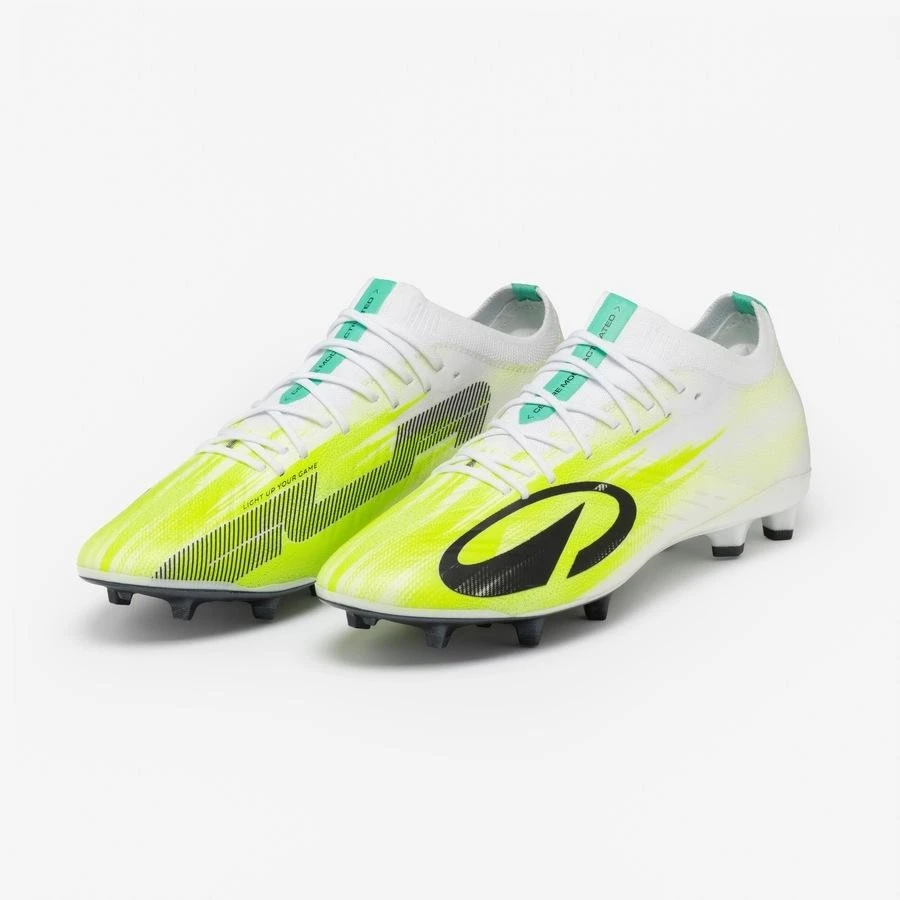
Speed boots are notoriously polarizing when it comes to ball feel. Because they are engineered to be as light as possible, they offer virtually zero padding. If you trap a ball poorly in a speed boot, you will feel the sting of your mistake.
Kipsta utilizes a proprietary ‘Skin Touch Control’ upper on the CLR 7 Elite. It is a paper-thin synthetic material that completely eliminates the barrier between your foot and the ball. This is where the concept of lightweight precision comes into play.
By removing padded foams and heavy leather, the CLR 7 provides a raw, one-to-one sensory experience. When the ball makes contact with the upper, the nerve endings in your foot receive immediate, unfiltered feedback. For highly technical players, this barefoot sensation is critical. It allows you to feel the exact texture of the ball, making it easier to manipulate spin, execute delicate dinks over the goalkeeper, and keep the ball glued to your instep during high-speed dribbling.
The Final Verdict
The Kipsta CLR 7 Elite FG is not just a good boot for the price; it is a brilliant boot, full stop.
By combining a professional-grade Pebax soleplate, traditional laced lockdown, and an ultra-thin upper, Kipsta has engineered a professional product that exposes the inflated pricing of the modern market. Antoine Griezmann did not choose this boot out of charity; he chose it because it delivers the exact lightweight precision required to dictate the tempo of elite European football.

The next time you are choosing a football boot, ignore the logo on the side. Look at the lacing system. Bend the soleplate. Feel the upper. The CLR 7 Elite proves that when you prioritize actual engineering over brand prestige, you don’t have to pay a premium to find a game-changer.
Tech Specs: Kipsta CLR 7 Elite FG
| Feature | Specification |
| Boot Category | Lightweight Speed |
| Upper Material | ‘Skin Touch Control’ Ultra-thin Synthetic |
| Soleplate | Responsive Pebax® Polymer |
| Stud Configuration | Firm Ground (FG) – TPU Chevrons |
| Closure System | Traditional Laced (Internal Midfoot Cage) |
| Weight | ~200g (varies slightly by size) |
| Endorsed By | Antoine Griezmann |
| Retail Price | ~£80.00 / €90.00 |