To isolate the precise, haunting beauty of the defining moment in the Iniesta 2010 World Cup Spain final clash, one must first actively deafen themselves to the deafening roar of the African winter night and locate the impossible, agonizing silence of the 116th minute. It is July 11, and the heavy, freezing high-altitude air of Johannesburg has choked the life out of the Soccer City stadium. Look closely at the right edge of the penalty area. The dark navy blue fabric of the Spanish away jersey, darkened entirely by a hundred and fifteen minutes of freezing sweat and sheer, unrelenting terror, clings desperately to the pale, fragile frame of Andrés Iniesta. He does not possess the heavily armored musculature of a traditional gladiator; his skin is almost translucent in the harsh glare of the floodlights, giving him the aura of a phantom wandering a battlefield.
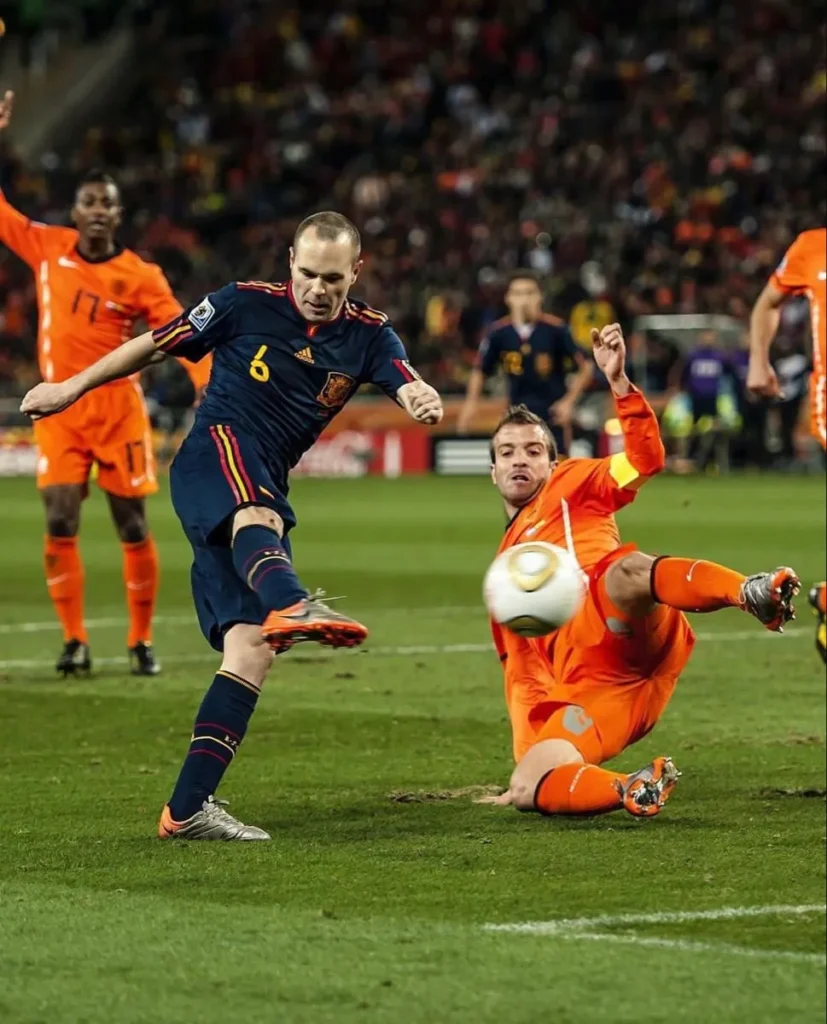
Focus entirely on the synthetic sphere hovering in the thin air. The Jabulani , a deeply controversial, violently unpredictable ball that had terrorized goalkeepers for a month, suddenly loses its chaotic malice. Cesc Fàbregas has pushed a desperate, heavily weighted pass through the shattered remnants of the Dutch defense. The ball bounces once. The tension in Iniesta’s jaw is painfully visible, a rigid, desperate lock as his eyes track the trajectory. In this microscopic fraction of a second, the relentless, droning swarm of ninety thousand horns simply ceases to exist in his consciousness. The world fundamentally pauses. He perfectly angles his right hip. He draws back his boot. The ritual of a nation’s salvation is about to be physically realized.
To fully comprehend the crushing atmospheric density of this singular bounce, we must pull back the lens and examine the heavy, blood-stained tapestry of the tournament’s climax. The global congregation of the sport had descended upon South Africa expecting a coronation of beauty, but instead found themselves trapped in a grueling, deeply cynical war of attrition. The pitch in Johannesburg was not a canvas for artistic expression; it was a heavily mined trench, a stage for a violent ideological collision.
For decades, the Spanish national team had been defined by a deep, inescapable tragedy. They were the eternal underachievers, a fractured nation fielding a team historically known as La Furia Roja, the Red Fury. But fury had never yielded gold; it had only yielded heartbreaking, visceral exits and a heavy, compounding national trauma. To shatter this curse, they had radically evolved. The Spain 2010 tactics were not built on fury; they were constructed upon a suffocating, hypnotic, geometric web of possession known as tiki-taka. It was an intricate system heavily dependent on microscopic spatial awareness, woven entirely by the diminutive, brilliant architects of the midfield. They sought to kill their opponents not with a sword, but with a thousand beautifully orchestrated paper cuts.
Waiting for them in the final, however, was a terrifying corruption of a sacred bloodline. The Netherlands, historically the romantic authors of Total Football, had deliberately abandoned their beautiful heritage. Recognizing that they could not out-pass the Spanish, they chose to physically dismantle them. They arrived on the pitch clad in their iconic vibrant orange, but they played with a cold, metallic brutality.
The match quickly devolved into a terrifying spectacle of physical intimidation. The defining image of the first ninety minutes was not a sweeping pass, but the horrifying, visceral violence of Nigel de Jong’s studs burying themselves deep into the sternum of Xabi Alonso. The sound of the impact echoed sickeningly over the relentless, droning hum of the vuvuzelas. The English referee, Howard Webb, trapped in the center of the maelstrom, lost control of the narrative, handing out yellow cards like desperate, meaningless confetti. The beautiful game had been dragged into the dark, unforgiving mud. Through a hundred and fifteen minutes of heavy, lung-burning exhaustion, Spain’s delicate, woven masterpiece had been violently battered, but miraculously, it had not snapped.
The players are no longer functioning purely on oxygen; they are moving through a heavy, invisible molasses born of pure adrenaline and absolute desperation. The Dutch are down to ten men, their cynical armor finally cracked by the expulsion of John Heitinga.
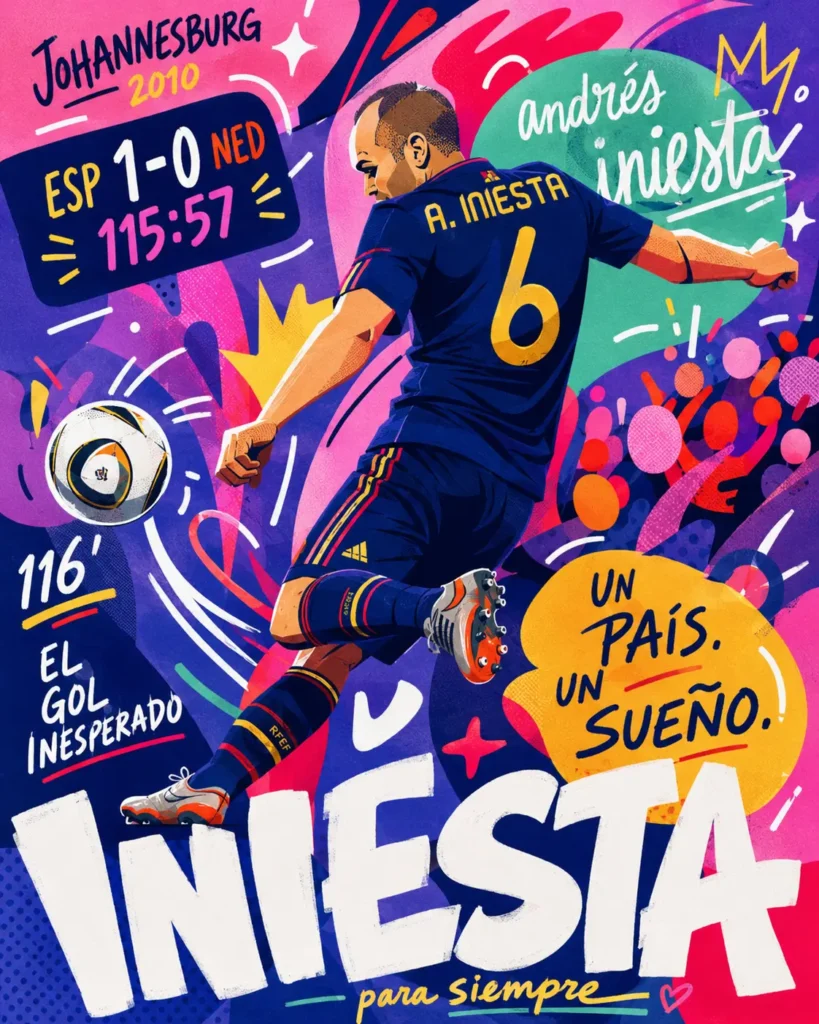
It is the 116th minute. Jesus Navas, a blur of exhausted momentum, initiates a desperate surge down the right flank. The ball travels through a chaotic, heavily congested midfield, eventually finding the feet of Fernando Torres. A heavy, looping cross is wildly deflected. Fàbregas controls the chaotic rebound at the edge of the box.
Fàbregas sees the pale ghost drifting into the right side of the penalty area. The pass is a heavy, sliding thrust across the meticulously cut turf. Rafael van der Vaart, tracking back with lungs screaming for air, lunges desperately, but he is a fraction of a second too late.
The ball reaches Iniesta. It bounces once, rising to the exact height of his right knee. He does not attempt to control it. He does not take a touch to settle the heavy, synthetic leather. Operating entirely on instinct honed on the concrete courts of Fuentealbilla, he violently torques his torso. His right boot sweeps through the high-altitude air, perfectly connecting with the unpredictable Jabulani on the half-volley.
The strike is clean, pure, and devastatingly lethal. Maarten Stekelenburg, the towering Dutch goalkeeper, launches his massive frame toward the far post, his arm fully extended in a desperate, sprawling arc. But the ball is a blurry white comet, tearing through the humid night air and violently ripping into the side netting.
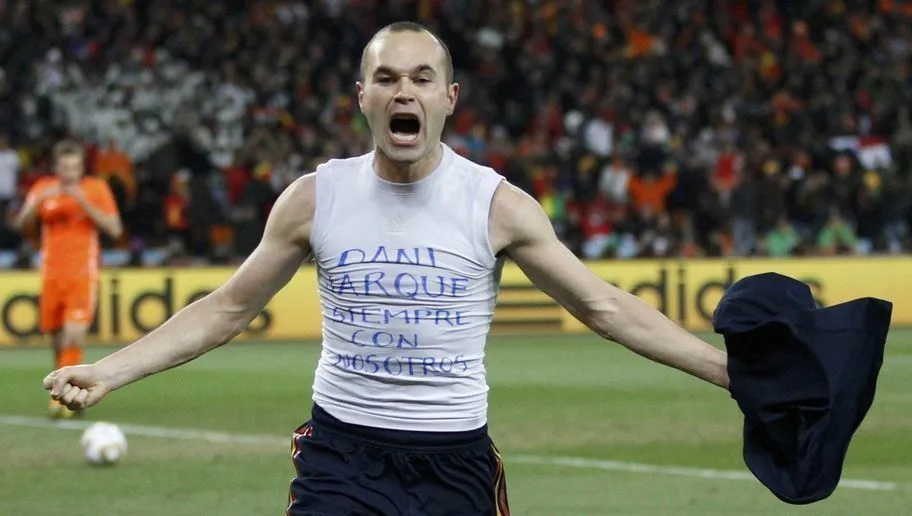
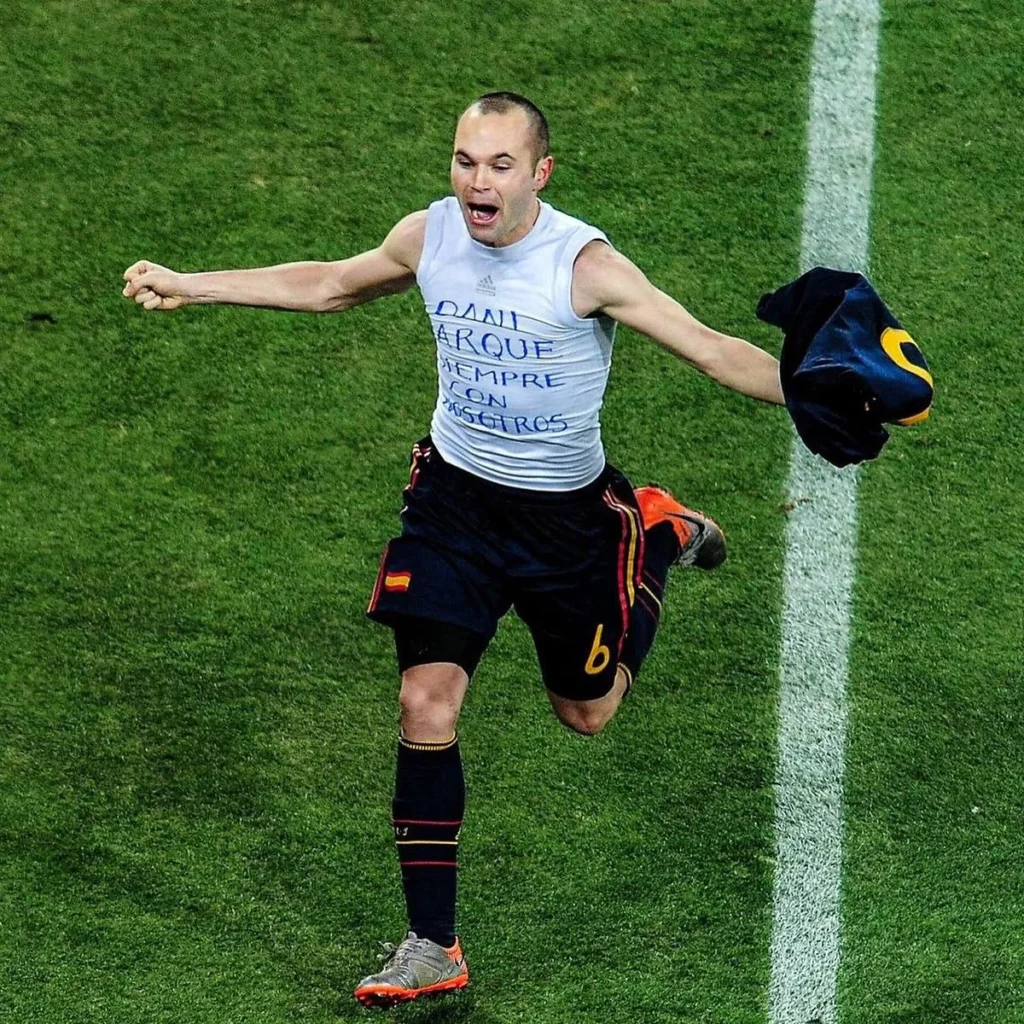
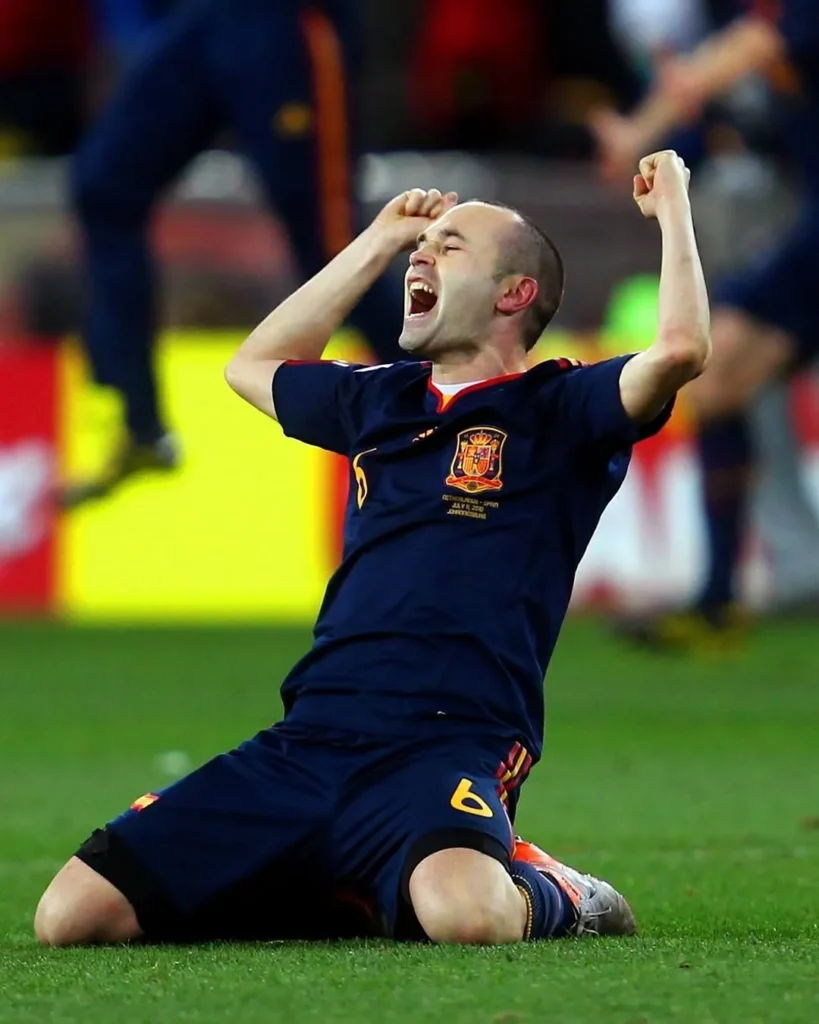
The immediate aftermath is not merely a celebration; it is a seismic, primal explosion of relief. But watch closely what Iniesta does as he sprints frantically toward the corner flag. In the absolute, undisputed peak of his professional existence, with the entire globe watching his every movement, he does not bask in the selfish glory of the magic he has just created.
He violently tears off his dark navy blue jersey, aggressively casting it to the turf. Beneath the heavy, sweat-soaked armor, he wears a plain white undershirt with a message hastily, desperately scribbled in blue marker: Dani Jarque, siempre con nosotros. (Dani Jarque, always with us).
Dani Jarque, the captain of Espanyol and Iniesta’s close, beloved friend, had died of a sudden, tragic heart attack less than a year prior. In the very moment he immortalized himself and shattered a century of Spanish failure, Iniesta actively chose to summon the dead. He invited his friend to stand beside him in the blinding light, transforming the goal from a mere athletic achievement into a profound, devastatingly beautiful act of human devotion. The referee, bound by the cold, unfeeling bureaucracy of the rulebook, brandishes a yellow card for the removal of the shirt, a hilariously insignificant, meaningless gesture in the face of such profound, spiritual triumph.
When the final whistle finally cuts through the freezing Johannesburg night, Spain are crowned champions, and the heavy, golden trophy is lifted into a storm of golden confetti. But the true, enduring legacy of the evening was sealed in the silence of that half-volley and the devastating poetry of the white undershirt.
Today, the tactical ecosystem of the sport has been permanently altered by the events of 2010. The world watched the Spanish triumph and aggressively attempted to clone the methodology. The modern game is now heavily saturated with teams attempting to play out from the back, obsessing over possession statistics, and attempting to replicate the hypnotic, geometric webs of tiki-taka.
Yet, as we watch the sterile, algorithmic passing sequences of the modern, heavily commercialized era, we are often left with a cold, aching emptiness. The modern replications are mathematically precise, but they fundamentally lack the soul of the original. We long for the raw, desperate vulnerability that defined the Spanish journey. The modern disciples of the tactic have inherited the blueprints, but they do not possess the magic.
The cult of Andrés Iniesta was fundamentally canonized on that freezing July night. He became a living deity not because he possessed terrifying physical speed or arrogant, cinematic flair, but because he moved through a violent, brutalist warzone with the quiet, devastating grace of a ghost.
If you stand in the colossal, silent bowl of Soccer City today, long after the vuvuzelas have faded into a distant, historical hum, you can still feel the heavy, oppressive tension of the 116th minute. The stadium is permanently haunted by the memory of the pale boy who waited for the perfect bounce, struck the ball with the heavy weight of a grieving heart, and proved that even in a world descending into cynical violence, pure, undeniable beauty always has the final word.