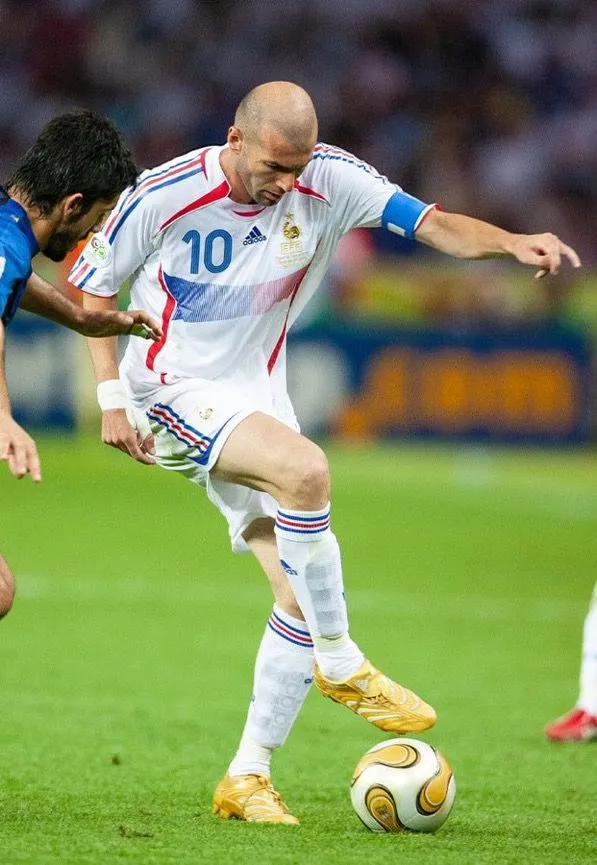
To locate the true, agonizing genesis of the Zidane 2006 world cup final headbutt Italy vs France showdown, one must not look to the 110th minute of the match, but to the very first. It is the evening of July 9, and the oppressive, electric air of the Olympiastadion in Berlin is thick with the scent of freshly cut turf and impending finality. Focus your gaze entirely on the boots. They are a bespoke, shimmering gold, Adidas Predator Absolutes, crafted exclusively for the retiring maestro. Notice how the heavy, golden leather bites into the damp earth, how the pristine white of the French away jersey clings to a body hardened by thirty-four years of relentless, bruising combat.
In the seventh minute, a penalty is awarded. Stand behind the ball and feel the suffocating, paralyzing weight of the moment. Facing him is Gianluigi Buffon, a towering, impenetrable monument of Italian goalkeeping. A normal man, burdened by the gravity of a global final, would choose power, driving the ball with terrified force. Zinedine Zidane chooses Panenka. He chips the ball with a delicate, arrogant flick of the golden boot. It rises in a lazy, agonizing arc, kissing the underside of the crossbar, and dropping over the line. It is an act of pure, visceral magic. But beneath the roaring adulation of the congregation, a dangerous precedent is set. In that singular moment of supernatural defiance, Zidane establishes that he is operating entirely outside the boundaries of mortal physics and consequence. He is a god walking among men, and gods do not take kindly to being pulled back down to the concrete.
The Fractured Tapestry of the France 2006 World Cup Journey and the Italian Shield
To understand the immense, crushing atmospheric pressure of the Berlin night, we must pull back the lens and examine the heavy, frayed tapestry of the era. The France 2006 World Cup campaign was not a joyous, sunlit march to glory; it was a grueling, desperate resurrection. The French nation was internally fractured, its suburbs still bearing the heavy, charred scars of the violent 2005 riots. The national team, managed by the deeply eccentric and heavily maligned Raymond Domenech, was a chaotic, aging entity. They had limped through qualification, requiring a desperate, almost mythical un-retirement of their golden generation—Zidane, Lilian Thuram, Claude Makélélé—to save them from the abyss.
They arrived in Germany as ghosts of their former 1998 glory. Yet, as the tournament progressed, a strange, beautiful alchemy took hold. Zidane, orchestrating the midfield with a glacial, hypnotic grace, single-handedly dismantled the vibrant, heavily favored Spaniards and the reigning Brazilian champions. He moved across the pitch not with explosive pace, but with an inevitable, terrifying geometric precision. He was the sole author of French salvation, carrying the entire psychological weight of a deeply anxious republic upon his aging shoulders.
Waiting for them in the suffocating amphitheater of the Olympiastadion was Italy. The Azzurri were a nation shrouded in their own deep, administrative darkness, reeling from the catastrophic Calciopoli match-fixing scandal that had shattered their domestic league. Stripped of their institutional pride, Marcello Lippi’s men had forged a terrifying, metallic unity. They were a cynical, heavily armored phalanx, anchored by Fabio Cannavaro and Marco Materazzi, a defender whose game was built entirely on physical intimidation, dark arts, and psychological warfare. The stage in Berlin, a stadium burdened by its own dark, monumental history, was set for an ideological collision. It was the fragile, fading magic of the artist against the cold, unbreakable steel of the executioner.
The Ritual of the 110th Minute: The Zidane, 2006 world cup, final, headbutt, Italy vs France Tragedy
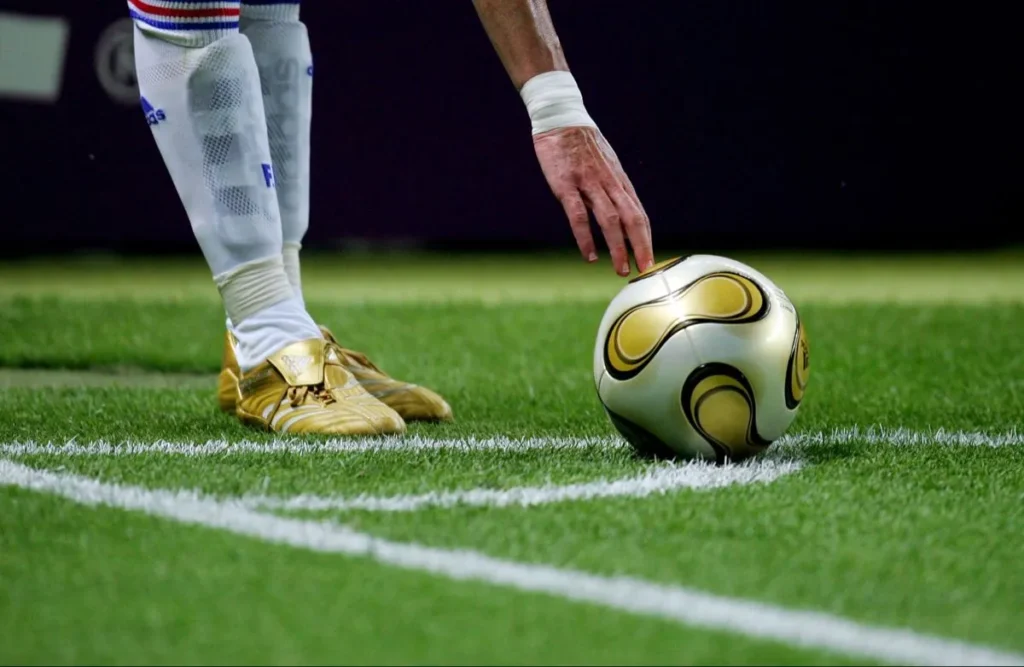
The match had deteriorated into a brutal, lung-burning war of attrition. Marco Materazzi had equalized, a towering, violent header that erased the opening magic. Now, deep into the second half of extra time, the physical toll is agonizingly visible. The players are dragging their legs through invisible water, the sweat heavily staining the fabric of their armor.
It is the 110th minute. The ball is cleared away from the Italian penalty area, drifting harmlessly toward the center circle. The camera isolates Zidane and Materazzi jogging back in tandem.
Slow the footage down until it is almost a crawl. Notice the physical grappling, a dark, hidden ritual enacted a thousand times in every match. Materazzi’s hand reaches out, tightly gripping the white fabric of Zidane’s jersey, a cynical anchor designed to impede, to frustrate, to assert a petty, structural dominance. Zidane stops. The physical connection breaks. Words are exchanged, a sudden, sharp poison injected into the heavy, humid air of the capital.
Zidane initially walks away, his back turned to the Italian. A sardonic, hollow smile dances on his lips, a fleeting shadow of the supreme arrogance that dictated his opening penalty. He is three steps away. The tension seems to dissipate into the night sky. But the words linger. They hang in the air, pulling at the fraying edges of his exhaustion.
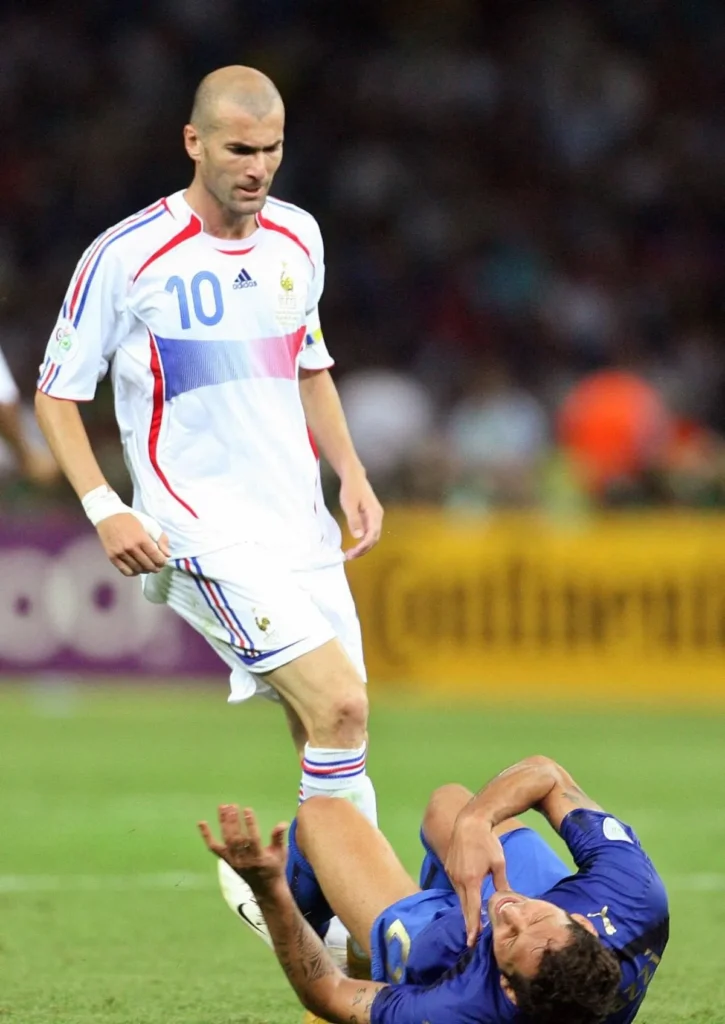
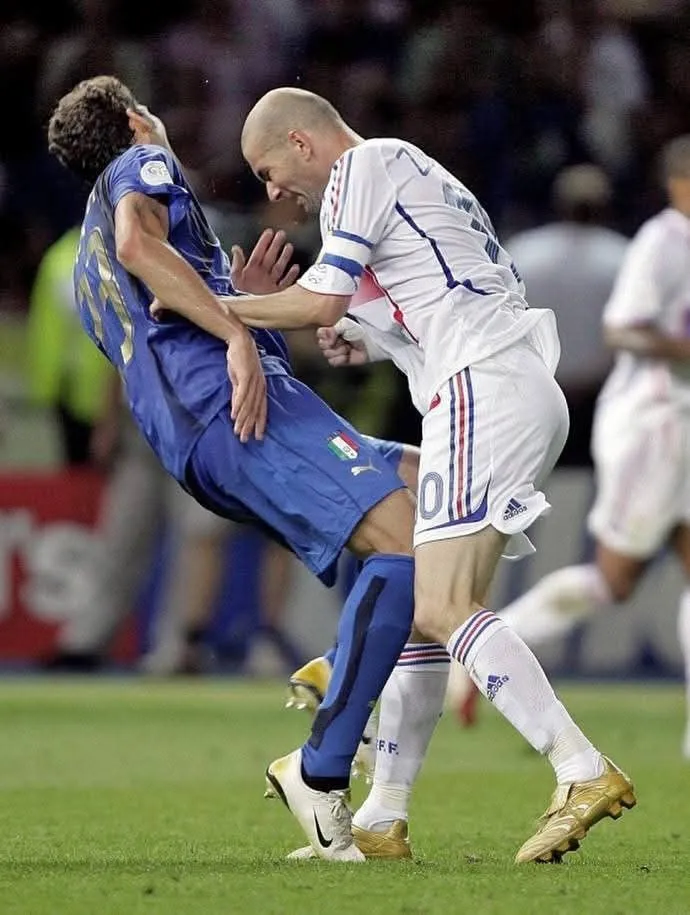
Suddenly, the poetic meter of his entire career violently fractures. Zidane stops. He pivots on the heavy, studded soles of the golden boots. The rhythmic, hypnotic elegance of the maestro is instantly replaced by the primal, unthinking instinct of the street fighter from La Castellane. He lowers his head.
The movement is shocking in its ferocity. There is no hesitation, no calculation of the consequences. He drives his skull directly into the sternum of Marco Materazzi.
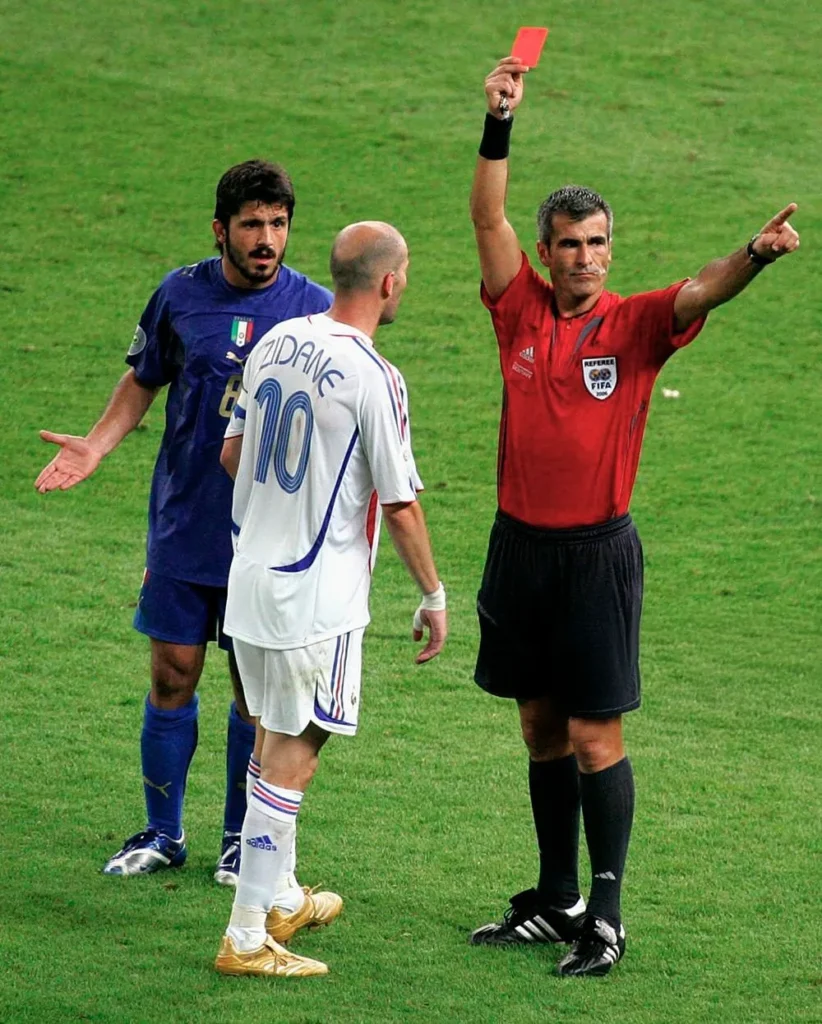
The sound of the impact is lost to the deafening roar of the seventy-thousand-strong crowd, but the visual violence is absolute. Materazzi falls backward, his body crashing heavily onto the meticulously cut turf. For a brief, terrifying second, time completely stops. The ball is far away, the play continuing blindly, oblivious to the fact that the universe has just shattered at the center of the pitch. Buffon frantically waves his arms, a desperate, screaming herald of the catastrophe. Horacio Elizondo, the referee, consults his assistant through his earpiece. The heavy, inevitable silence descends upon the French squad. The red card is drawn, a sharp, crimson blade cutting through the artificial daylight of the floodlights. The magic is dead.
The Lonely Walk and the Ghosts of the Golden Trophy
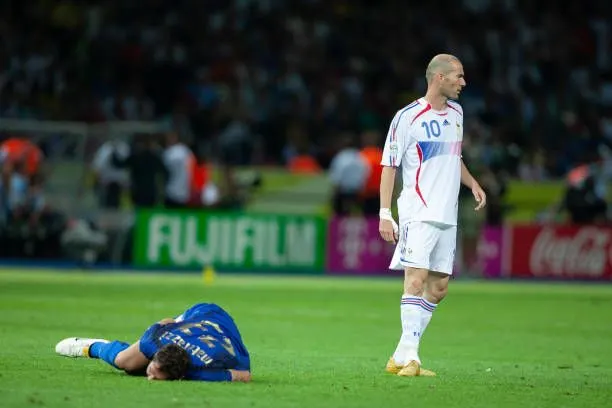
The match will eventually stagger to a penalty shootout. David Trezeguet’s strike will violently hit the crossbar, and Fabio Grosso will bury his effort, sealing a 5-3 victory for the Italians. But the shootout is a cold, mechanical footnote. The true, eternal echo of the 2006 World Cup final was forged in the devastating silence of a man walking away.
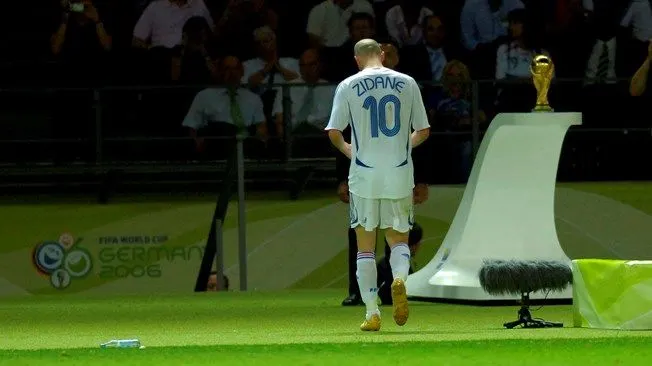
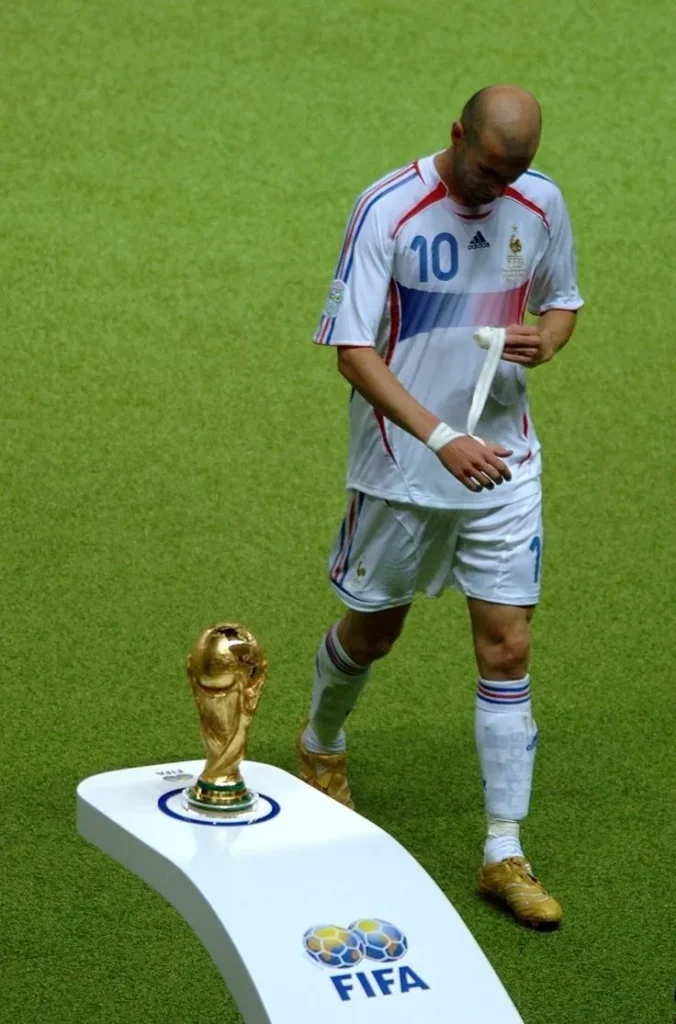
As Zidane leaves the pitch, expelled from the congregation, he must traverse the perimeter of the Olympiastadion. His head is bowed, his dark, exhausted eyes staring fixedly at the concrete beneath his feet. He walks past the World Cup trophy. It sits on a pedestal, gleaming with a flawless, immaculate golden light, mere inches from his shoulder. He does not look at it. He walks into the suffocating darkness of the tunnel, leaving the sport he had dominated for a decade in a state of absolute, traumatized shock.
In the highly sanitized, heavily regulated ecosystem of the modern game, where every player is a carefully managed corporate asset and every narrative is smoothed into a digestible PR statement, the sheer, destructive humanity of the Berlin headbutt is impossible to replicate. It is the ultimate, tragic anomaly. We are drawn to it not because we condone the violence, but because it is a devastatingly honest portrait of a deeply flawed genius.
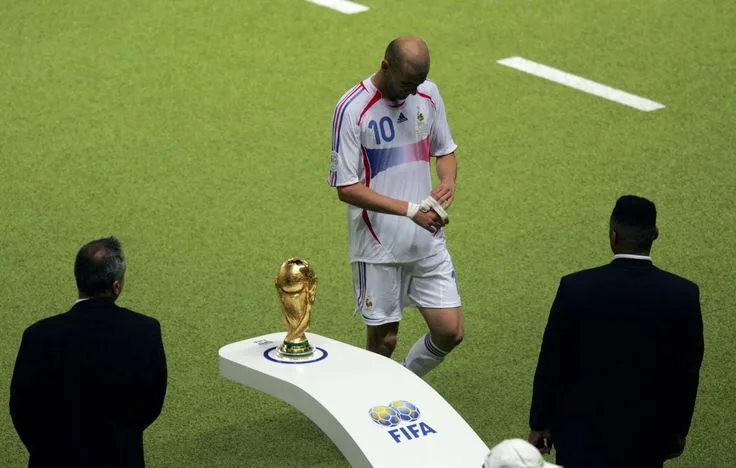
The cult of Zidane is inextricably linked to this final, fatal rupture. We revere him precisely because he was not a machine. He carried the impossibly heavy weight of an entire nation until his muscles screamed and his spirit fractured, proving that even the most beautiful art can instantly devolve into primitive rage.
If you walk the empty, silent concourses of the Olympiastadion today, you can still feel the heavy, oppressive weight of that July night. The stadium holds the memory of the golden boots and the red card, forever haunted by the lonely, vanishing silhouette of the number 10. He was a god who demanded to be remembered not just for the celestial beauty of his flight, but for the brutal, unforgiving impact of his fall.